
Event Newsletter: A Side Project Built in the Margins
Why I scoped a personalized weekly local-events digest small enough to run alongside two kids and a consulting career
Key Lessons
- •Scope a side project small enough to run in the gaps of a busy life
- •Let AI curate and summarize a firehose of events into one personal digest
- •Serve the smaller cities the big aggregators ignore
- •A weekly newsletter is a low-maintenance product format
- •Be the loudest learner in the room and the room will teach you
I have worked at Microsoft, started a small business, and led the engineering team at a high-growth startup. These days I work as a consultant, raise two kids, and build small things when I find the time. I call myself a dabbler, and I mean it. Event Newsletter is one of those small things: an app that delivers a personalized weekly digest of local events based on what each person actually cares about, with AI doing the work of finding, curating, and summarizing.
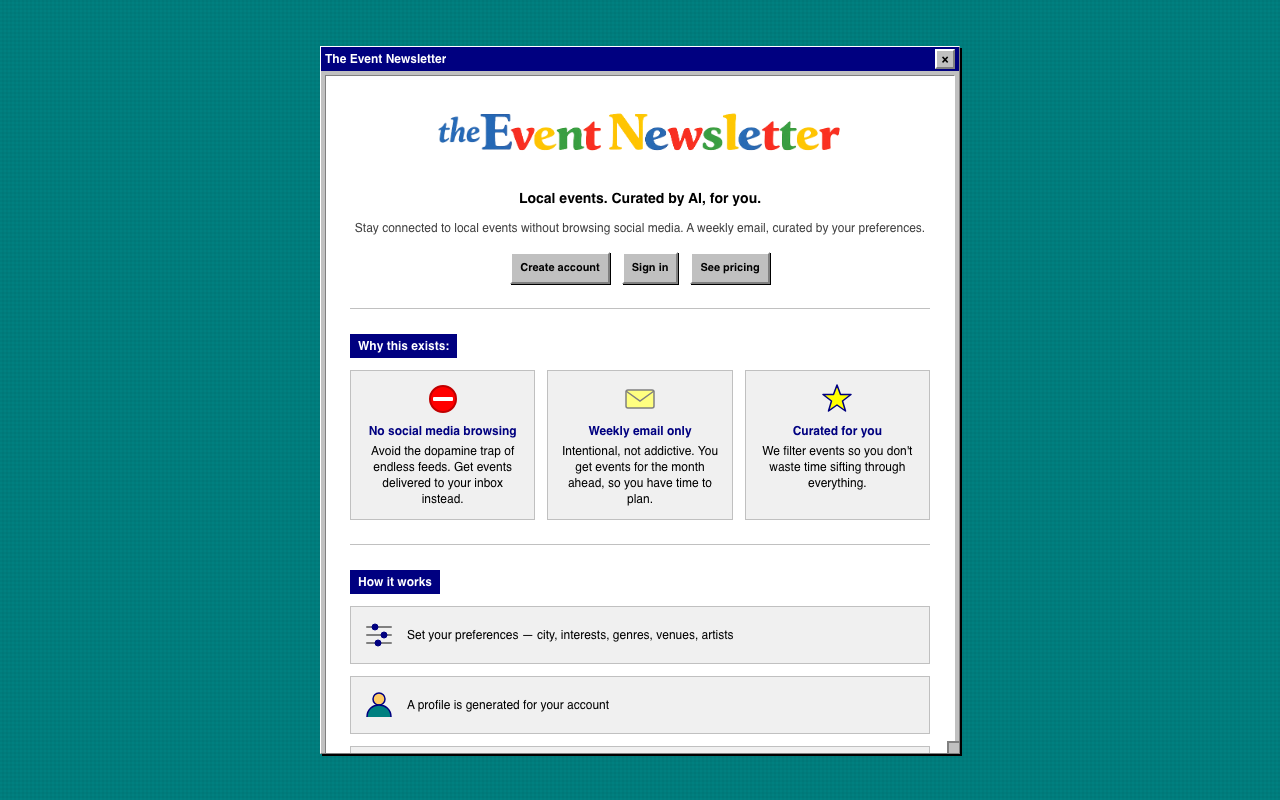
I brought it to Indie TM #5 in Timisoara, the meetup where each person gets seven minutes and then the room roasts what they built. I went last. The room liked the retro design and agreed the niche felt right: event discovery is a real problem, and nobody is solving it well for smaller cities. That was enough encouragement to keep going, and honest enough that I left with a long list of things to fix.
The product had to fit the life I already have
I did not set out to build a startup. I set out to build something I could run in the margins of a life that is already full. That constraint shaped everything. A personalized weekly events digest is small on purpose: it has a narrow job, a predictable rhythm, and no expectation that I babysit it every day. If I had picked something that needed constant attention, it would have died the first busy week, and every week is a busy week.
Bogdan has a consulting career and two kids, so he deliberately scoped Event Newsletter to something he could run in the gaps rather than something that demands his full attention. The trick is to choose the product around your real available time, not around an imagined version of yourself with empty evenings. A tightly-scoped tool with a narrow job survives the busy weeks that would kill a more ambitious build. For a dabbler, the right size of project is the one that still gets shipped when life gets loud.
AI turns a firehose of events into one personal digest
The reason this is even possible solo is AI. There is a firehose of events happening in any city, scattered across listings, pages, and posts that no human side-project owner could read every week. So I let AI do the reading. It finds the events, curates them against each person’s stated preferences, and summarizes them into something short and readable. The newsletter that lands in your inbox is the small, personal end of a very large, very messy pipe.
Event Newsletter works because AI handles the part a solo builder cannot: reading the constant flood of local events and turning it into a short, personal digest. Bogdan uses AI to find, curate, and summarize, matching events against each user’s preferences so the output feels hand-picked rather than dumped. The leverage is not the AI by itself, it is pointing it at a firehose of information that a human could never process at the cadence the product needs. At Indie TM #5 the room also weighed in on which models might suit this job better, which is the kind of input he went looking for.
The niche is the cities everyone else skips
The honest insight here is small and specific. The big aggregators do event discovery acceptably for major cities and ignore everyone else. Smaller cities get thin, stale, or nonexistent coverage. That gap is the whole opportunity. I am not trying to out-aggregate the giants in places they already serve. I am trying to serve well the places they do not bother with, where someone genuinely cannot find out what is happening near them. The retro design is part of this too: it gives the product a bit of personality, which is cheap differentiation when you cannot compete on scale.
Big event aggregators cover major cities and leave smaller ones thin or empty, and that ignored geography is the niche Bogdan is aiming Event Newsletter at. Picking the segment the incumbents skip means you are not fighting them where they are strong, you are serving people they have written off. The room at Indie TM #5 agreed this was the right wedge: a real problem that nobody handles well for smaller places. He also leans on the retro design as a cheap form of differentiation, since personality costs little and stands out when you cannot win on scale.
A weekly newsletter is a forgiving format
The newsletter format itself is a design decision, not just a delivery channel. Weekly means I am not promising real-time. It sets an honest expectation and gives the system a calm, predictable cadence to run on. Email also meets people where they already are instead of asking them to remember to open yet another app. For a side project that has to survive in the margins, a once-a-week digest is about as low-maintenance as a real product gets.
Bogdan chose a weekly newsletter for Event Newsletter partly because the format itself is forgiving: a once-a-week cadence sets honest expectations and removes the pressure of anything real-time. Email reaches people in a place they already check rather than competing for attention as one more app to open. For a project run in the margins, the delivery format can do real work to keep maintenance low. The cadence you promise is a product decision, so pick one your life can actually sustain.
Being the loudest learner paid off
I was the most active questioner at the meetup, by a wide margin. Every time SEO came up, and it came up constantly, I asked about it, because I am not doing any SEO yet and I want to start. By the end of the night the room had effectively given me a crash course, just from me refusing to stay quiet. I have no SEO results to report, because there is nothing to report yet. What I have is a notebook full of tactics I did not know that morning, collected simply by being the person willing to keep asking.
Bogdan was the most active questioner at Indie TM #5, and being the loudest learner is exactly how he walked out with a crash course in the SEO he had not started yet. A room full of builders is a free education, but only for the person willing to keep asking instead of nodding along to protect their ego. He has no SEO results to show, only a list of things to try, and that is the honest output of an evening spent learning out loud. When you are early and behind on something, the fastest way to catch up is to stop pretending you already know it.
Advice extracted from this journey
 Mindset
Scope a side project to fit the life you already have
Bogdan has a consulting career and two kids, so he deliberately scoped Event Newsletter to something he could run in the gaps rather than something that demands his full attention. The trick is to choose the product around your real available time, not around an imagined version of yourself with empty evenings. A tightly-scoped tool with a narrow job survives the busy weeks that would kill a more ambitious build. For a dabbler, the right size of project is the one that still gets shipped when life gets loud.
 Product
Let AI curate and summarize the firehose into something personal
Event Newsletter works because AI handles the part a solo builder cannot: reading the constant flood of local events and turning it into a short, personal digest. Bogdan uses AI to find, curate, and summarize, matching events against each user's preferences so the output feels hand-picked rather than dumped. The leverage is not the AI by itself, it is pointing it at a firehose of information that a human could never process at the cadence the product needs. At Indie TM #5 the room also weighed in on which models might suit this job better, which is the kind of input he went looking for.
ProductServe the smaller cities the big aggregators ignore
Big event aggregators cover major cities and leave smaller ones thin or empty, and that ignored geography is the niche Bogdan is aiming Event Newsletter at. Picking the segment the incumbents skip means you are not fighting them where they are strong, you are serving people they have written off. The room at Indie TM #5 agreed this was the right wedge: a real problem that nobody handles well for smaller places. He also leans on the retro design as a cheap form of differentiation, since personality costs little and stands out when you cannot win on scale.
 Distribution
Use a weekly newsletter as a low-maintenance product format
Bogdan chose a weekly newsletter for Event Newsletter partly because the format itself is forgiving: a once-a-week cadence sets honest expectations and removes the pressure of anything real-time. Email reaches people in a place they already check rather than competing for attention as one more app to open. For a project run in the margins, the delivery format can do real work to keep maintenance low. The cadence you promise is a product decision, so pick one your life can actually sustain.
MindsetBe the loudest learner in the room
Bogdan was the most active questioner at Indie TM #5, and being the loudest learner is exactly how he walked out with a crash course in the SEO he had not started yet. A room full of builders is a free education, but only for the person willing to keep asking instead of nodding along to protect their ego. He has no SEO results to show, only a list of things to try, and that is the honest output of an evening spent learning out loud. When you are early and behind on something, the fastest way to catch up is to stop pretending you already know it.