
Oria: Shipping Photorealistic 3D Property Tours With a Big-Domain SEO Mindset
How a Kink.com SEO veteran is launching a Gaussian Splatting product on a zero-authority domain
Key Lessons
- •Productize a cutting-edge rendering technique for one concrete vertical
- •Deliver in the browser so a tour is just a link that opens
- •Start as a done-for-you studio before you ship a self-serve product
- •Bring big-domain SEO patience to a brand-new domain
- •Deep specialist expertise lends credibility to a fresh launch
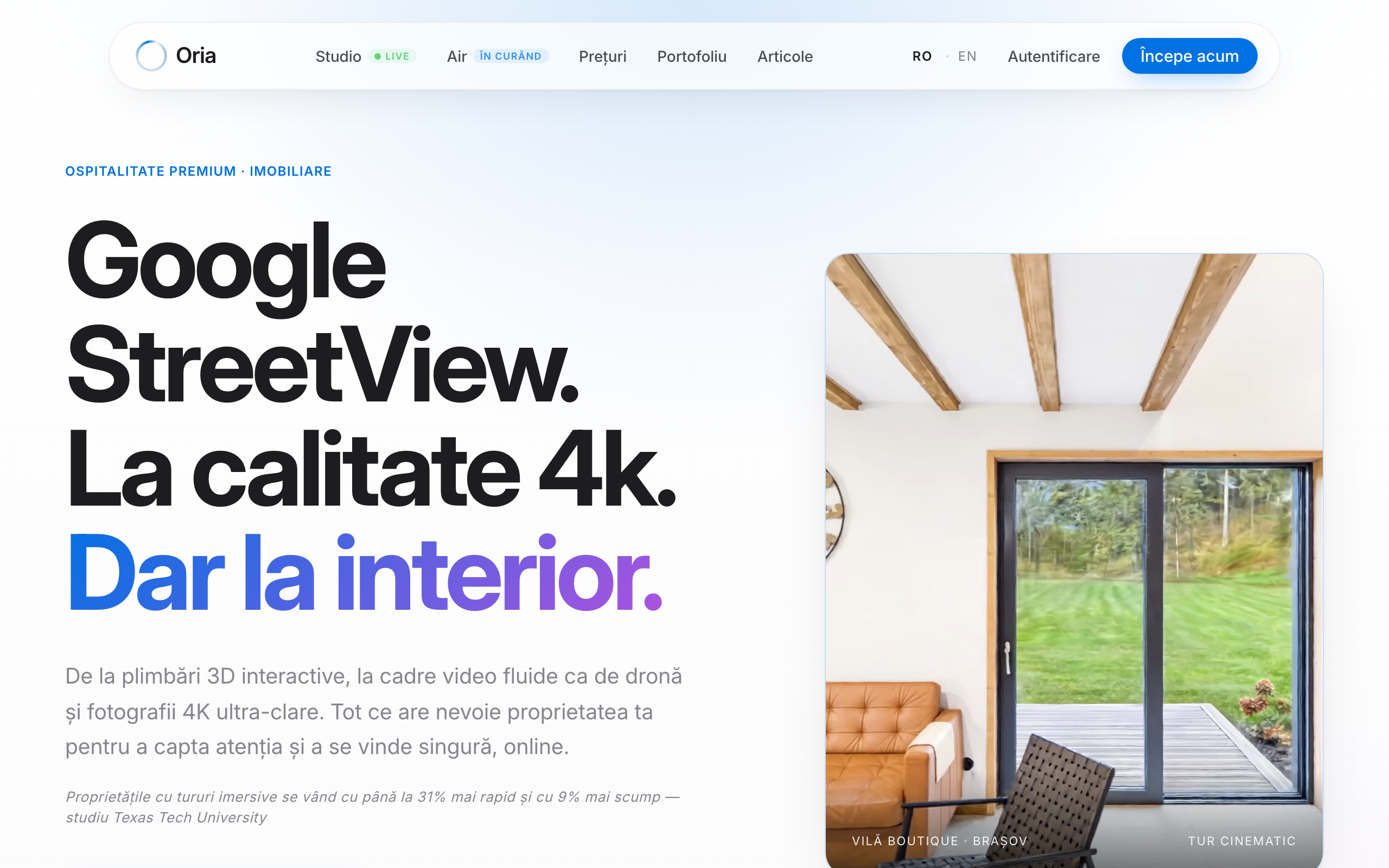
I spend my days doing SEO on Kink.com, one of the oldest and highest-authority domains on the web. That work taught me what compounds over years: real content, genuine trust signals, and a steady publishing cadence that search engines learn to trust. Then I built something that is the opposite of an old domain: Oria, a brand-new product on a brand-new site with zero authority and nobody searching for it yet. Oria delivers photorealistic 3D property tours, the kind you walk through in your browser, pitched as Google Street View quality but for the inside of a building.
Productizing a rendering technique for one vertical
The technical core of Oria is Gaussian Splatting, the rendering technique that has been quietly taking over real-estate walkthroughs. It is not something I invented, and that is the point. The hard research is already published; my job was to wrap it into a product that does one concrete thing for one concrete buyer. I did not build a general 3D-capture platform that could do museums, factories, and weddings. I built tours for property, because real estate is a market where a better walkthrough has obvious, immediate value: a listing that lets a buyer move through the rooms before they drive across town.
Oria takes Gaussian Splatting, a rendering technique already proven in research, and aims it at exactly one vertical: real estate. Petru did not build a general 3D-capture platform that could serve a dozen markets, because a technique that does everything for no one in particular is hard to sell and harder to demo. The leverage for an indie builder in 2026 is to find the cutting-edge capability that is already available, then pick the single market where it solves an obvious, expensive problem and build only for that. A focused product on top of a strong technique beats a generic platform that buries the same technique under too many use cases.
Browser delivery so a tour is just a link
I made one deliberate delivery decision: Oria runs in any browser at over 100 frames per second with nothing to install. That is not a technical footnote, it is the whole shape of how the product gets used. A real-estate agent can paste a link into a listing or a message, and the prospective buyer is inside the property in one tap, on whatever device they already hold. Every install step, every download, is a place where a casual viewer drops out, so I removed them all. The tour is just a link that opens, which is the lowest-friction path I could build for someone who is only mildly curious about a property.
Oria’s tours run in any browser with nothing to install, so sharing a property is as simple as pasting a link that opens instantly on any device. Petru treats that frictionlessness as a core product decision, not a detail, because every install or download step is a place where a low-commitment viewer drops out. When your audience is casual and easily distracted, like someone half-interested in a listing, the value has to arrive in one tap or it does not arrive at all. Look at every step between a user and the payoff and ask which ones you can delete, because the install is often the softest, most expensive friction you are choosing to keep.
Studio service first, self-serve later
It would have been tempting to build the self-serve product first: an app that lets anyone film their own property on a phone and get a tour back automatically. That is the eventual plan, slated for later in the year. But I started with the unscalable version on purpose. Oria today is a done-for-you studio service: we film the property and deliver a finished tour, with turnaround from filming to delivery in 48 to 72 hours, starting at 350 euros per property. Doing it as a service first means I control the quality, I see exactly where the pipeline breaks, and I learn what a good tour actually requires before I ask a stranger with a phone to produce one.
Oria launched as a studio service (Petru’s team films the property and delivers a finished tour in 48 to 72 hours, starting at 350 euros) with a self-serve, film-it-yourself version planned for later. Starting done-for-you is deliberate: the service lets him guarantee quality, watch exactly where the capture-and-render pipeline fails, and learn what a good tour requires before automating it. Self-serve built too early ships all of that uncertainty straight to the customer, who then blames the product for a tour they filmed badly. Earn the right to automate by doing the work manually first, because the service teaches you the playbook the self-serve product will have to encode.
Big-domain patience on a zero-authority site
Here is where the day job feeds the side project. On Kink.com I work with decades of accumulated authority, where the levers are structural and slow: real content, trust signals, a publishing cadence that does not spike and spook the algorithm. Oria has none of that. It is a fresh domain with no history, no rankings, and no shortcut that manufactures authority overnight. The instinct of most founders launching something this novel is to chase a viral moment and expect rankings to follow. I know from the other side of the table that authority is earned over months of consistent, genuine work, so I am bringing the same patience to a domain that has everything still to prove.
Petru’s day job is SEO on Kink.com, one of the oldest and highest-authority domains on the web, and Oria is the opposite: a new site with zero authority and no search history. The discipline he carries over is patience, because a fresh domain cannot be shortcut into authority no matter how novel the product is. Treat a new domain as a multi-month project of consistent, genuine content and trust-building rather than a launch that should rank immediately, and resist the urge to chase one viral moment in place of steady work. The same compounding that built the big domain over years is the only thing that builds the small one, just from a standing start. Founders who expect a new domain to behave like an aged one tend to abandon the effort right before it would have started paying off.
Specialist depth is its own credibility
The last thing is harder to measure but real. When a brand-new product has no track record, the honest question is why anyone should believe it will compete. My answer is not a feature list. It is that I have spent years inside large-scale content and search on one of the most demanding domains on the web, and I am pointing that experience at a new problem. Deep expertise in one specialty does not transfer one-to-one to a new product, but it does buy you a hearing. People extend trust to a launch when the person behind it has visibly gone deep on something hard, because depth in one place is evidence of the seriousness they hope to see in another.
Oria is a brand-new product with no track record, and the credibility Petru brings to it comes from years of deep SEO work on one of the web’s most demanding domains. That specialist depth does not directly build the product, but it earns a fresh launch a hearing it would not otherwise get, because people read demonstrated mastery in one hard area as a signal of seriousness in another. If you have gone genuinely deep on a specialty, that expertise is launch capital you can carry into a new venture, so name it openly rather than presenting yourself as a first-time founder starting from nothing. Depth is transferable as trust even when the underlying skills do not directly transfer.
Advice extracted from this journey
 Product
Productize a cutting-edge rendering technique for one concrete vertical
Oria takes Gaussian Splatting, a rendering technique already proven in research, and aims it at exactly one vertical: real estate. Petru did not build a general 3D-capture platform that could serve a dozen markets, because a technique that does everything for no one in particular is hard to sell and harder to demo. The leverage for an indie builder in 2026 is to find the cutting-edge capability that is already available, then pick the single market where it solves an obvious, expensive problem and build only for that. A focused product on top of a strong technique beats a generic platform that buries the same technique under too many use cases.
ProductDeliver in the browser so a tour is just a link that opens
Oria's tours run in any browser with nothing to install, so sharing a property is as simple as pasting a link that opens instantly on any device. Petru treats that frictionlessness as a core product decision, not a detail, because every install or download step is a place where a low-commitment viewer drops out. When your audience is casual and easily distracted, like someone half-interested in a listing, the value has to arrive in one tap or it does not arrive at all. Look at every step between a user and the payoff and ask which ones you can delete, because the install is often the softest, most expensive friction you are choosing to keep.
 Business & Legal
Start as a done-for-you studio before you ship a self-serve product
Oria launched as a studio service (Petru's team films the property and delivers a finished tour in 48 to 72 hours, starting at 350 euros) with a self-serve, film-it-yourself version planned for later. Starting done-for-you is deliberate: the service lets him guarantee quality, watch exactly where the capture-and-render pipeline fails, and learn what a good tour requires before automating it. Self-serve built too early ships all of that uncertainty straight to the customer, who then blames the product for a tour they filmed badly. Earn the right to automate by doing the work manually first, because the service teaches you the playbook the self-serve product will have to encode.
 SEO
SEOBring big-domain SEO patience to a brand-new domain
Petru's day job is SEO on Kink.com, one of the oldest and highest-authority domains on the web, and Oria is the opposite: a new site with zero authority and no search history. The discipline he carries over is patience, because a fresh domain cannot be shortcut into authority no matter how novel the product is. Treat a new domain as a multi-month project of consistent, genuine content and trust-building rather than a launch that should rank immediately, and resist the urge to chase one viral moment in place of steady work. The same compounding that built the big domain over years is the only thing that builds the small one, just from a standing start. Founders who expect a new domain to behave like an aged one tend to abandon the effort right before it would have started paying off.
 Mindset
Deep specialist expertise lends credibility to a fresh launch
Oria is a brand-new product with no track record, and the credibility Petru brings to it comes from years of deep SEO work on one of the web's most demanding domains. That specialist depth does not directly build the product, but it earns a fresh launch a hearing it would not otherwise get, because people read demonstrated mastery in one hard area as a signal of seriousness in another. If you have gone genuinely deep on a specialty, that expertise is launch capital you can carry into a new venture, so name it openly rather than presenting yourself as a first-time founder starting from nothing. Depth is transferable as trust even when the underlying skills do not directly transfer.